Showing posts with label Florissant. Show all posts

Friday, September 6, 2013

The Late Bloomers

For the first time last week, I began to hear the familiar begging calls of young American Goldfinches. I peeked outside and sure enough, there were 3 hatch year Goldfinches on my patio hopping around, pecking at leaves and exploring the covered BBQ pit. One of the goldfinches hopped under the BBQ pit, another one perched on a flower pot, and the last goldfinch started to fly towards the BBQ pit. I think he was trying to reach the top of the pit, but his takeoff was too close, so he settled for the side instead.

A hatch year Goldfinch looks very different from his or her parents. In that same turn, male and female goldfinches also look different from each other. This difference in the feather colors between males and females is known as sexual dimorphism. During the summer, male goldfinches are bright yellow with a black head and wings. The females are a muted yellow, and lack the black head.

The young goldfinches were in various stages of learning to feed themselves. One little goldfinch begged his sibling for food...while on the bird feeder. But there was another young goldfinch that was beginning to master the art of foraging. This little one was plucking seeds off my Purple Coneflowers (Echinacea purepurea) in the backyard.

American Goldfinches nest later than other songbirds. Most birds breed late April through mid June but the goldfinches begin breeding in late June through July. These birds breed when milkweed, thistle and other plants have produced their fibrous seeds. The female builds the nest, usually in a shrub or sapling in a fairly open setting rather than within a forest. The nest is often built high in a shrub, where two or three vertical branches join; usually shaded by leaves of clusters of needles from above, but often open and visible from below. The nest is an open cup of plant fibers and rootlets and the interior is lined with the fluffy material surrounding the seed from thistle and other plants. The nest is so tightly woven that it can hold water. 

Goldfinches are seed eaters, even during the breeding season. While most seed eaters, such as Sparrows, switch to an insect diet during the summer months, the goldfinches continue their seed eating diet and feed their young the seeds from trees, flowers, and shrubs.


You can find American Golfinches in parks, weedy fields, pastures, grasslands and in fields containing mature sunflowers. They will also eat from bird feeders that offer sunflower and thistle.

You may think that the bright yellow colors of the American Goldfinch really stand out - and indeed they do in a backyard while perched on a bird feeder. But out in a field of flowers, they are well camouflaged. Can you find the Goldfinch in this picture?


Be on the lookout for our pretty yellow feathered friends. If you are around a small field of, or even a cluster of dried flowers, the Goldfinches are sure to be nearby. 

Glossary

Hatch Year: A bird that has hatched during the spring or summer. A young bird will be considered a hatch year bird until January 1st, when all are then considered adult birds.

Camouflage: The colors and markings of an animal or bird that allow it to blend in with its surroundings so as not to be detected by predators.

Saturday, July 6, 2013

The Sounds of Summer

I was in the park one evening last week when I heard the cicadas sing for the first time this season. I love this time of the year, if only for the cicadas and their song. It's free entertainment in the parks, neighborhoods and your backyard. I will often hang out on the patio during the evening to listen to their metallic buzz that builds up in volume until it gradually softens and dies out, only to repeat the chorus again. I find most insects interesting, and the cicadas are no exception.

Let's start at the beginning of the cicada's life cycle.  After mating, the female will make a long slit in a young twig and deposit her eggs.  These slits will often kill the affected twigs, especially oak and hickory trees. If you look carefully, you can find where the females have been actively laying eggs. There will usually be small clusters of brown leaves (especially on the lower part of a tree) among the healthier, green leaves of a tree.

Cicadas undergo simple metamorphosis. After hatching, the young nymphs fall to the ground, burrowing under the ground to feed on sap from tree roots. Nymphs can live up to 20 years, depending on the species and food availability. Periodical cicadas have life cycles of either 13 or 17 years. When the nymphs mature (from Mid-May through July), they tunnel up from underground and crawl onto the trunks of trees or other surfaces. You can look for their emergence holes around tall trees. These holes are about the size of a pinky and there is no excavated soil around the holes.

The new adults will split from their old exoskeletons and emerge in their new bodies. The adults appear white because their new exoskeletons are soft. It takes several hours for the exoskeleton to harden and the adults to gain their characteristic colors.

After emerging, the adults begin to pump their wings up with blood in preparation to fly to the trees. The males begin singing soon after emergence and both sexes only live 5 to 6 weeks.

A cicada's body is made for singing. The adult male cicada possesses two ribbed membranes called tymbals, (think of drums) one on each side of its first abdominal segment. By contracting the tymbal muscle, the membrane collapses inward, producing a loud click. As the membrane snaps back, it clicks again. These muscles rapidly pull the tymbals in and out of shape and the sound is intensified by the cicada's mostly hollow abdomen. The vibrations travel through the body back to the tympani, which further strengthens their song. The male sings to attract a a female, or to socialize with their fellow cicadas.  Each Cicada species sings during a certain time of the day and in its own habitat. Some species only sing while perched on a certain type of plant. 

As a side note, it has been found that cicadas think the sounds made by power tools and lawn maintenance equipment are made by their fellow species. They get confused and will land on the people using the equipment! If this bothers you, cut your lawn in the early morning or near dusk when the cicadas are less active. 

Cicadas also have ways of protecting themselves from predators. Some cicadas will briefly sing from one perch before moving on to a different location. Many Cicada species have colors that blend in with their surroundings, known as camouflage. Singing at dusk makes it difficult for predators that hunt by sight. Other species have bright colors, such as red, that alert predators they are poisonous when ingested (Monarch Butterflies also display the same warning colors). There is also safety in numbers; a multitude of singing cicadas make it nearly impossible for a predator to single out one insect, and even the volume of the chorus can scare the predator away.

There are over 75 cicada species in North American.Two common cicada species in Missouri are the Dog-Day, or Annual Cicadas (Tibicen spp), and the Periodical Cicadas. Dog-day cicadas are larger than periodical cicadas. They are blackish in color and their wings have a greenish edging. Their life cycle lasts from two to five years, but because of overlapping generations, some adults appear every year (usually July through September).
Periodical Cidada. Picture taken in 2011.
The last Periodical Cicada outbreak was in the Summer of 2011

Other cicadas found in Missouri include:   

    Cicadetta calliope
    Neocicada hieroglyphica
    Tibicen pruinosus 
    Tibicen superbus    
Take pause next time you're outside and listen to the summer song of the Cicadas. What beautiful music these insects create. 

Glossary:

Exoskeleton: Skeletal structure formed on the external surface of insects.

Nymph: Immature stage of an insect with simple metamorphosis

Predator: Animal that moves and hunts smaller animals

Simple Metamorphosis: Pattern of metamorphosis that involves eggs, followed by immature nymphs, and finally adults.
 

Friday, June 28, 2013

Eurasian Tree Sparrows; A St. Louis Specialty

St. Louis is home to an Old World Sparrow that normally resides in Europe, the UK as well as China, and Japan. I'm talking about the Eurasian Tree Sparrow (Passer montanus). On April 25th 1870, Carl Daenzer and a Mr. Kleinschmidt released 20 Eurasian Tree Sparrows and a variety of other non-native finches in Lafayette Park.  German immigrants largely comprised this part of St. Louis and it was popular during this time period to release European birds in the hopes the introduced birds would control the existing insect population and give the immigrants a little taste of home in their new city. The Eurasian Tree Sparrows were the only birds that survived the release and quickly established a breeding population concentrated near the breweries in south St. Louis. 

It is speculated that the initial success of the Eurasian Tree Sparrow was due to the absence of their aggressive cousin the House Sparrow, which did not arrive in St. Louis until 1878. Once the House Sparrow reached St. Louis, the Eurasian Tree Sparrow population boom slowed but the species extended their range to the Illinois cities of East St. Louis, Alton, Grafton and Belleville, all within about 20 miles of their original point of release.

Today small colonies can be found in the City of St. Louis, Ladue, North St. Louis, Florissant, and east St. Charles County. There are now Eurasian Tree Sparrow colonies in Iowa as well. The first sighting of a pair of Eurasian Tree Sparrows was at West Branch in Cedar County Iowa in March 1987. There were no records for 2 more years, and then 10 birds were found in Des Moines County in December 1989.  A pair of Sparrows nesting was confirmed in Burlington in 1993. The Eurasian Tree Sparrow currently has breeding populations in Lee, Des Moines, Louisa and Muscatine counties
Adult Eurasian Tree Sparrow
A several years ago, I assisted UMSL on a study of Eurasian Tree Sparrows and their cousins the House Sparrows. Their findings suggested that Eurasian Tree Sparrows are homebodies and rarely migrate more than a mile from where they hatched. This could explain why their population has not spread across North America in the same manner as House Sparrows and European Starlings. But there are always the intrepid explorers among the colonies who do wander outside their point of origin and it appears they are following the path of the Mississippi River.


 Eurasian Tree Sparrows are social birds that prefer open fields with shrubby vegetation, especially agricultural areas. These ground feeding birds primarily live on a diet of weed, corn, millet, wheat and sunflower seeds, grass seed and seed shoots but feed their offspring a diet of insects and arachnids during the spring and summer months.
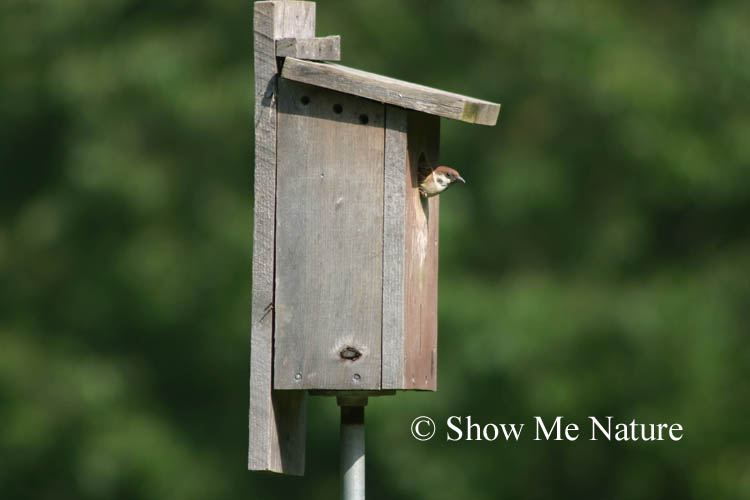
Breeding season begins in April for the Eurasian Tree Sparrow and ends in July (Baicich and Harrison 1997). These birds are cavity nesters, using tree holes, nest boxes or other man-made structures to build their nests.
These birds create an orb-shaped nest with the outer layer composed of coarse grass material and the inner portion lined with down and finer vegetative matter. Eurasian Tree Sparrows can have up to 4 broods per year, though 2-3 broods is the average. Each clutch consists of 1-8 oval eggs (but the average is closer to 4-5 eggs) and incubation lasts 11-14 days. The young fledge around 12-14 days.
 

Eurasian Tree Sparrow chick I banded last summer.
The House Sparrow (Passer domesticus), is an aggressive nest competitor with the Eurasian Tree Sparrow and will displace the latter species from a given habitat. Though both birds are able to adapt to many habitats, the House Sparrow appears to prefer urban areas while the Eurasian Tree Sparrow will occupy more rural, agricultural areas.  However, the Tree Sparrow will move into parks and suburban areas when pushed out of their preferred habitat by their House Sparrow cousins.           

I do know from personal experience that Eurasian Tree Sparrows do visit bird feeders and inhabit backyard nest boxes. Be on the lookout for that little sparrow with the black dot on its cheek.