Friday, September 6, 2013

The Late Bloomers

For the first time last week, I began to hear the familiar begging calls of young American Goldfinches. I peeked outside and sure enough, there were 3 hatch year Goldfinches on my patio hopping around, pecking at leaves and exploring the covered BBQ pit. One of the goldfinches hopped under the BBQ pit, another one perched on a flower pot, and the last goldfinch started to fly towards the BBQ pit. I think he was trying to reach the top of the pit, but his takeoff was too close, so he settled for the side instead.

A hatch year Goldfinch looks very different from his or her parents. In that same turn, male and female goldfinches also look different from each other. This difference in the feather colors between males and females is known as sexual dimorphism. During the summer, male goldfinches are bright yellow with a black head and wings. The females are a muted yellow, and lack the black head.

The young goldfinches were in various stages of learning to feed themselves. One little goldfinch begged his sibling for food...while on the bird feeder. But there was another young goldfinch that was beginning to master the art of foraging. This little one was plucking seeds off my Purple Coneflowers (Echinacea purepurea) in the backyard.

American Goldfinches nest later than other songbirds. Most birds breed late April through mid June but the goldfinches begin breeding in late June through July. These birds breed when milkweed, thistle and other plants have produced their fibrous seeds. The female builds the nest, usually in a shrub or sapling in a fairly open setting rather than within a forest. The nest is often built high in a shrub, where two or three vertical branches join; usually shaded by leaves of clusters of needles from above, but often open and visible from below. The nest is an open cup of plant fibers and rootlets and the interior is lined with the fluffy material surrounding the seed from thistle and other plants. The nest is so tightly woven that it can hold water. 

Goldfinches are seed eaters, even during the breeding season. While most seed eaters, such as Sparrows, switch to an insect diet during the summer months, the goldfinches continue their seed eating diet and feed their young the seeds from trees, flowers, and shrubs.


You can find American Golfinches in parks, weedy fields, pastures, grasslands and in fields containing mature sunflowers. They will also eat from bird feeders that offer sunflower and thistle.

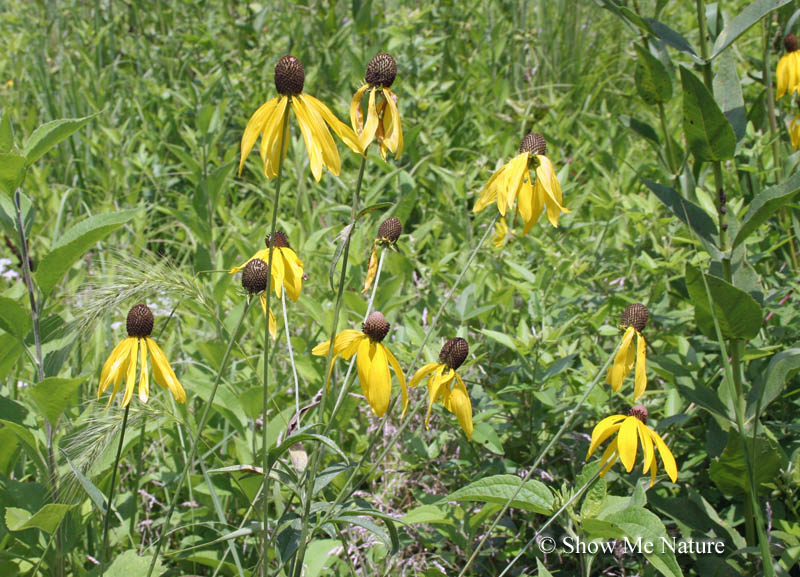
You may think that the bright yellow colors of the American Goldfinch really stand out - and indeed they do in a backyard while perched on a bird feeder. But out in a field of flowers, they are well camouflaged. Can you find the Goldfinch in this picture?


Be on the lookout for our pretty yellow feathered friends. If you are around a small field of, or even a cluster of dried flowers, the Goldfinches are sure to be nearby. 

Glossary

Hatch Year: A bird that has hatched during the spring or summer. A young bird will be considered a hatch year bird until January 1st, when all are then considered adult birds.

Camouflage: The colors and markings of an animal or bird that allow it to blend in with its surroundings so as not to be detected by predators.

Thursday, August 29, 2013

Summer's Last Hurrah

September is already upon us and summer is winding down to a close. The days are gradually getting shorter and the birds that spend their summers in St. Louis are beginning to migrate to their winter homes. Generally speaking in terms of migration, male birds are usually the first to leave, with females and young birds following suit.

There are still a few summer birds on the prairie, but most of them have left. An Indigo Bunting fussed at me as I walked.

It is difficult to determine if this is a female or a young Bunting. Adult male Indigo Buntings are a rich blue color, while their female and young counterparts are brown.

The American Goldfinches are abundant on the prairie right now.
They are busy eating the seeds from the Coneflowers, Cup Plants and the myriad of other flowering plants living on the prairie.

The bees are busier than ever collecting pollen, the cicadas are singing in the trees, butterflies flit from flower to flower and dragonflies dance across the sky.

A dragonfly can spend up to 5 years of its life as a nymph. The nymph form looks completely different from the adult form and lives in a completely different habitat - water. While the adult dragonfly is flying in the air, the nymph is developing underwater. Both the nymph and adult dragonflies eat mosquitoes, midges and other small bothersome insects.

The prairie is awash in yellow right now.
Sweet Coneflower (Rudbeckia subtomentosa) are the beautiful flowers responsible for the prairie's sunny color.
These moist-loving plants can be found in prairies, savannahs, thickets, floodplain forests, woodland borders, roadside ditches and riverbanks. Bloom time begins in July and lasts all the way through late fall.

Ironweed is also in bloom right now. Ironweed is in the asteraceae (daisy) family and there are many species of this plant in Missouri.
Ironweed can tolerate both wet and dry habitats and is found in prairies, meadows, fields, glades, dry woodland and along railroad tracks. They grow  3 - 5 feet in height and bloom July - September. The name Ironweed refers to the tough stems that are often difficult to dig up, and the flowers producing rust colored seeds. This plant is sometimes thought of as a weed because of its propensity to grow abundantly in fields and pastures.

Life may seem to be slowing down on the prairie, but this habitat is active year round. We'll see what is happening on the prairie next month.

Wednesday, August 7, 2013

An Overview of the Arachnids: Spiders, part one.


What is your reaction when you hear the word “spider”? Do you get a shiver down your spine? Do you feel fear or admiration?  There are often mixed reactions to spiders with movies and the media adding to the misunderstanding of our arachnid friends. The point to this entry is to educate readers on the natural history of spiders. You may still not enjoy being around  spiders after reading this blog entry, but perhaps you will take pause and decide not to kill that 8 legged critter scurrying up the wall. 

Spiders are not insects. They belong in the Arachnida class along with ticks, mites, harvestmen (daddy long legs) and scorpions.  There are about 40,000 known spider species. This is an impressive number, considering there are only 4,000 species in the mammal kingdom.   Missouri boasts 480 species of spiders.

Common Missouri Spider by Nancy Zuschlag. MDC Publication
Arachnids have 8 legs and two body parts, a cephalothorax (a fused head and thorax) and an abdomen.  Spiders have 8 eyes that are grouped in 4 pairs and despite all of those eyes, their sight is poor. To compensate for their poor eyesight, the body of a spider is covered in very sensitive hairs that pick up vibrations in their surroundings and the air.  

Spiders have fang-tipped jaws called chelicerae. They use these fangs to inject venom into their prey and to tear food apart before eating. Pedipalps, the limbs (they closely resemble the spider’s legs, but are smaller) in front of the fangs are used for reproduction, grabbing and killing their prey.  Arachnologists (scientists who study spiders) believe these limbs may also have a function similar to antennae. 

The abdomen contains the heart, lungs, digestive tube and spinnerets. The spinnerets, found at the back of the abdomen, produce silk. Spiders use this silk to create webs to trap prey, use as safety lines during climbing, building homes, mating, and egg sacs for their developing offspring. Incidentally, those newly emerged spiders release silk that catches in the wind and carries them to their new home.
Female Wolf Spider with eggs
 
Spider eggs enclosed in silk.
Believe it or not, those 8 legs of the spider have their functions as well. Arachnids can hear, feel and even smell with those legs. Their feet contain tiny claws that allow them to walk on their webs, and walk up smooth surfaces.

All spiders eat bugs and insects but they are separated into 2 different groups according to the way they catch their prey. Hunters, such as Jumping Spiders and Wolf Spiders, do not spin webs, but actively hunt and seize their prey. Trappers, such as Garden Spiders and Trap Door spiders, made webs and lie in wait for their prey.

Let’s spend some time learning about spider silk. Many arachnid species have been using the same genetic silk recipe for the last 125 million years and for good reason. It has been discovered that spider silk is more flexible than nylon and is five times stronger than steel.

Everyone knows that spider webs are made with silk. But what are the components of that web? Each web begins with a single thread that the spider releases into the wind. This single thread forms the foundation of the web. With any luck, the free end of the thread will catch onto another branch. If the thread catches on to something, the spider cinches the silk up and attaches the thread to the starting point. The spider walks across the thread, releasing a looser thread below the first one. The support structure of the web is formed when this thread is attached to both ends and the spider climbs to its center. This is known as the frame thread. The looser strand sags downward, forming a V-shape. The spider lowers itself from this point, to form a Y-shape. The spider continues to create frame threads between various anchor points. Then it begins to lay out non-sticky radius threads from the center of the web to the frames. After building all the radius threads, the spider lays more nonstick silk to form an auxiliary spiral, extending from the center of the web to the outer edge of the web. The spider then spirals in on the web, laying out sticky thread and using the auxiliary spiral as a reference.
Biology of the Invertebrates, 4th edition. Jan Pechenik.

 Once completed, the spider sits in the middle of the web and patiently waits for an unsuspecting insect to fly into its trap. Once its prey hits the web, the spider will feel the motion through the radius threads and make its way to the vibration source. These spiders have the ability to tell the difference between vibrations from insect prey and other sources (such as a breeze, or a leaf falling into the web). Many species can also distinguish the characteristic vibrations of dangerous insects, such as wasps.
Spider eating bee.
Spider silk is a fairly new area of study for Arachnologists and its use holds much promise for the human world.  In a 2002 issue of the Science journal, the US Army and a Canadian biotechnology company reported that they had manufactured and spun the first man-made fiber with mechanical properties similar to that of natural drag line silk. Creating silk is difficult and time consuming (spiders only contain a small amount of silk and mass rearing spiders is a difficult, if not impossible undertaking) but this discovery opens up many potential applications of silk: Body armor (similar to Kevlar), ropes, athletic attire, and medical device components. The list can go on and on.

All spiders have venom but in most arachnids species the venom is not toxic to humans. These eight-legged creatures prey on small insects and do not have the venom geared towards large animals, such as humans. The mouth parts of a spider are not even capable of piercing human skin. Most spiders do not want to bite, but in the unlikely event that it does happen, it’s usually because a person steps on an arachnid with a bare foot or reaches into an article of clothing that the spider currently inhabits.
A great deal of research has gone into spider bites and several studies have discovered that most “spider bites” are not spider bites, but rather allergies, skin reactions, chemicals, biting fleas or bedbugs, infections, poison ivy or oak, among other possibilities. 

Although spiders may be hated and are low on the cuteness meter, they play an important part in our world. That pesky spider that has set up shop in the corner of your ceiling or the baseboard may be preying upon unseen insects in your home, insects that are more likely to bite humans. Spiders can also be a farmer’s best friend. Arachnologists have estimated up to 11,000 spiders per acre in woodlands to more than 2.5 million individuals in a grassland acre. Since each spider in a field may consume at least one insect per day, their cumulative effect on insect populations is significant.  These hungry spiders prey upon grasshoppers, flies, moths, caterpillars, leafhoppers, some bees and ants, and other spiders. If you still dislike the spiders, think about this; spiders are an important food source for birds and other animals. 

Look for an upcoming entry on some of the spider species found in Missouri.

Glossary:

antennae: a pair of sense organs located near the front of an insect's head. Antennae are usually covered with receptors that can detect odors. Many insects also use their antennae as humidity sensors, to detect sounds and some insects (flies) gauge air speed while they are in flight.

arachnid: A variety of arthropods of the class Arachnida, such as spiders, scorpions, mites, and ticks. Arthropods are characterized by the absence of antennae, four pairs of segmented legs and a body that is divided into two regions, the cephalothorax and the abdomen.

genetic (genetics): The branch of biology dealing with heredity. Heredity is a biological process where a parent passes certain genes, such as eye and hair color, onto their children.

natural history: the study of animals and plants.

offspring: new organism produced by a living thing.

thorax: the middle region of the body of an insect.

venom: a poisonous fluid secreted by certain snakes and scorpions usually transmitted by a bite or sting.

Wednesday, July 17, 2013

The Prairie in July

The dog days of summer are here in St. Louis and the flowers on the prairie continue to bloom in the July heat.

The Bee Balm (Monarda fistulosa) is in bloom. This perennial is in the mint family (Lamiaceae) and is a favorite of Hummingbirds and countless butterflies.


The Slender Mountain Mint (Pycnanthemum tenuifolium), another plant in the mint family, continues to bloom and the flowers have been keeping the bees busy.
All plants in the mint family (as well as a few other plants in different families) have square stems.


The tall spikes of Culver's Root (Veronicastrum virginicum) are showing off their delicate white flowers.

There are patches of Culver's Root all over  the prairie.

Nodding Bulrush (Scirpus pendulus) and other sedges are blooming and going to seed.
Nodding Bulrush

Sedge species

Gray-headed Coneflower (Ratibida pinnata) are showing off their yellow flowers.
This plant is in the Asteraceae family as is the Purple Coneflower, Sunflower, Coreopsis and Black and Brown-eyed Susans. This is the largest family in Missouri, with 78 genera and 274 species.
Rosinweed (Silphium intergrifolium), another plant in the Asteraceae family is in bloom as well.

Blackberries are beginning to ripen, providing food for the birds and other animals living in the prairie.
All of these plants will continue to bloom throughout the summer. Stayed tune for next month's phenological events!

Glossary


Perennial: a non-woody plant with a root system that lives through the winter, emerges in the spring and dies back to the ground in the fall.

Saturday, July 6, 2013

The Sounds of Summer

I was in the park one evening last week when I heard the cicadas sing for the first time this season. I love this time of the year, if only for the cicadas and their song. It's free entertainment in the parks, neighborhoods and your backyard. I will often hang out on the patio during the evening to listen to their metallic buzz that builds up in volume until it gradually softens and dies out, only to repeat the chorus again. I find most insects interesting, and the cicadas are no exception.

Let's start at the beginning of the cicada's life cycle.  After mating, the female will make a long slit in a young twig and deposit her eggs.  These slits will often kill the affected twigs, especially oak and hickory trees. If you look carefully, you can find where the females have been actively laying eggs. There will usually be small clusters of brown leaves (especially on the lower part of a tree) among the healthier, green leaves of a tree.

Cicadas undergo simple metamorphosis. After hatching, the young nymphs fall to the ground, burrowing under the ground to feed on sap from tree roots. Nymphs can live up to 20 years, depending on the species and food availability. Periodical cicadas have life cycles of either 13 or 17 years. When the nymphs mature (from Mid-May through July), they tunnel up from underground and crawl onto the trunks of trees or other surfaces. You can look for their emergence holes around tall trees. These holes are about the size of a pinky and there is no excavated soil around the holes.

The new adults will split from their old exoskeletons and emerge in their new bodies. The adults appear white because their new exoskeletons are soft. It takes several hours for the exoskeleton to harden and the adults to gain their characteristic colors.

After emerging, the adults begin to pump their wings up with blood in preparation to fly to the trees. The males begin singing soon after emergence and both sexes only live 5 to 6 weeks.

A cicada's body is made for singing. The adult male cicada possesses two ribbed membranes called tymbals, (think of drums) one on each side of its first abdominal segment. By contracting the tymbal muscle, the membrane collapses inward, producing a loud click. As the membrane snaps back, it clicks again. These muscles rapidly pull the tymbals in and out of shape and the sound is intensified by the cicada's mostly hollow abdomen. The vibrations travel through the body back to the tympani, which further strengthens their song. The male sings to attract a a female, or to socialize with their fellow cicadas.  Each Cicada species sings during a certain time of the day and in its own habitat. Some species only sing while perched on a certain type of plant. 

As a side note, it has been found that cicadas think the sounds made by power tools and lawn maintenance equipment are made by their fellow species. They get confused and will land on the people using the equipment! If this bothers you, cut your lawn in the early morning or near dusk when the cicadas are less active. 

Cicadas also have ways of protecting themselves from predators. Some cicadas will briefly sing from one perch before moving on to a different location. Many Cicada species have colors that blend in with their surroundings, known as camouflage. Singing at dusk makes it difficult for predators that hunt by sight. Other species have bright colors, such as red, that alert predators they are poisonous when ingested (Monarch Butterflies also display the same warning colors). There is also safety in numbers; a multitude of singing cicadas make it nearly impossible for a predator to single out one insect, and even the volume of the chorus can scare the predator away.

There are over 75 cicada species in North American.Two common cicada species in Missouri are the Dog-Day, or Annual Cicadas (Tibicen spp), and the Periodical Cicadas. Dog-day cicadas are larger than periodical cicadas. They are blackish in color and their wings have a greenish edging. Their life cycle lasts from two to five years, but because of overlapping generations, some adults appear every year (usually July through September).
Periodical Cidada. Picture taken in 2011.
The last Periodical Cicada outbreak was in the Summer of 2011

Other cicadas found in Missouri include:   

    Cicadetta calliope
    Neocicada hieroglyphica
    Tibicen pruinosus 
    Tibicen superbus    
Take pause next time you're outside and listen to the summer song of the Cicadas. What beautiful music these insects create. 

Glossary:

Exoskeleton: Skeletal structure formed on the external surface of insects.

Nymph: Immature stage of an insect with simple metamorphosis

Predator: Animal that moves and hunts smaller animals

Simple Metamorphosis: Pattern of metamorphosis that involves eggs, followed by immature nymphs, and finally adults.